

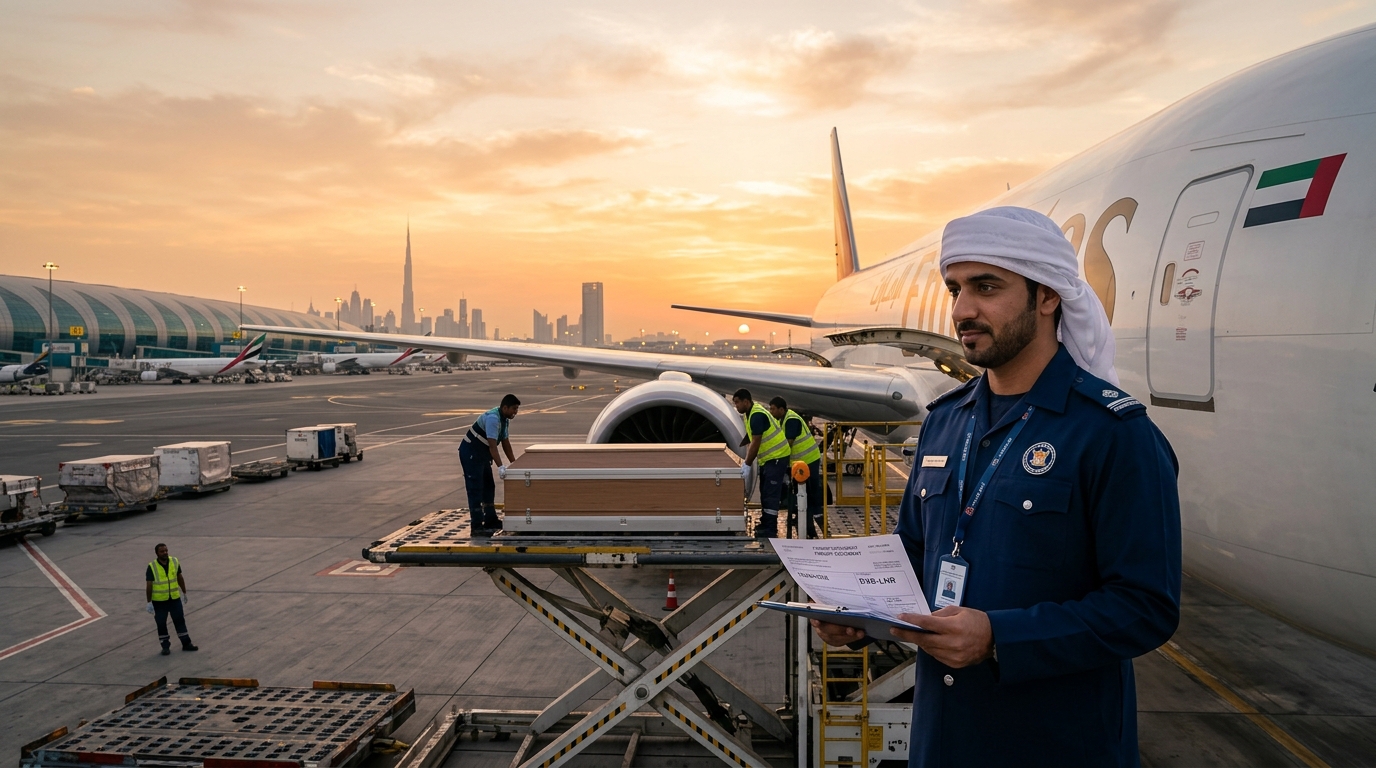
Human remains repatriation refers to the process of returning a deceased individual's body or ashes from the UAE to their home country for final rites. This process can be particularly overwhelming for families, especially when facing language barriers and the grief of loss. Within the UAE, the repatriation process necessitates navigating various formalities involving medical, police, embassy, and airline procedures in a specific order to ensure the body is released for transport.
In the UAE, each authority (Hospital → Police → Health Authority → Embassy → Airport Cargo Customs) requires the output certificate of the previous step. Attempting procedures out of sequence leads to avoidable delays.
Who Can Initiate the Repatriation Process?
Typically, the repatriation process can be initiated by the next of kin, an employer, or a designated representative. It may also involve engaging a licensed repatriation service provider.
Before an embassy issues a no objection certificate, the next of kin may be required to sign an affidavit or consent letter. If the next of kin is not physically present in the United Arab Emirates, this authorization can generally be executed through an embassy-certified Power of Attorney (POA) or a formalized consent affidavit authorizing a licensed repatriation partner such as Naro Cargo to carry out all procedures on their behalf.
Documents Required for Repatriation from the UAE
Obtaining the required permits and approvals is the core of the repatriation procedure. Documents required for repatriation can include:
- 1Original passport of the deceased and visa copy Required for immigration cancellation and embassy registration.
- 2Emirates ID of the deceased Original card or digital record via ICP for resident file closure.
- 3Death notification from a hospital or a forensic report Issued immediately by the treating hospital or the police forensic department if applicable.
- 4Official death certificate from the health authority Issued by MOHAP (Ministry of Health and Prevention), DHA (Dubai Health Authority), or DoH/SEHA (Abu Dhabi).
- 5Police No Objection Certificate (NOC) Official clearance for the release of the body, embalming, and international transport.
- 6Embassy or consulate NOC along with death registration Consular approval from the home country's diplomatic mission in the UAE permitting entry of the remains.
- 7Embalming certificate Issued by the government embalming center certifying sanitization, hermetic sealing, and compliance with IATA travel standards.
- 8Airline or cargo booking confirmation Confirmed Air Waybill (AWB) booking on an authorized commercial airline scheduled to the destination airport.
- 9Legal translations of any Arabic documents Sworn legal translations into English or the destination country's official language, where requested by foreign border controls.
It is advisable to have multiple photocopies of these documents, as various authorities often request them. During the process, copies are submitted at police desks, mortuary counters, embassy registrars, customs clearing bays, and airline handling terminals.
Duration and Timeline Expectations
One of the foremost questions asked by grieving families is how long the repatriation procedure will take. The duration varies depending on the circumstances of the passing:
Factors such as weekends, public holidays, embassy operating hours, and flight availability can further affect this timeline. Working with an experienced cargo coordinator ensures flight bookings are synchronized with the exact moment paperwork is finalized, avoiding expensive delays.
Understanding the Cost of Repatriation
The cost of repatriation varies, influenced by the destination, weight of the coffin, airline charges, and required services. Typically, repatriation costs include embalming, transport, documentation, and air cargo fees.
Destination Distance
Long-haul routes to Europe or North America usually incur higher expenses compared to closer destinations in Asia or the Middle East.
Coffin & Casket Specs
Airlines mandate a hermetically sealed zinc-lined inner casket encased in an outer wooden shipping container, charged by volumetric weight.
Government Mortuary & Embalming
Official fees for washing, embalming sanitization, coffining certificates, and death registration.
Local Hearse Transit
Authorized, refrigerated transport between the hospital mortuary, embalming facility, and airport cargo apron.
Employer & Insurance Coverage: Families should check their loved one's employment contracts and insurance policies, as some may cover repatriation costs entirely. Under UAE labor laws, many employer contracts or group life insurances contain dedicated repatriation allowances to support bereaved families.
Why Utilizing a Professional Repatriation Service Eases the Burden
Utilizing a professional repatriation service can significantly ease the burden on bereaved families. A licensed service provider manages critical interactions with hospitals, police, and embassies, oversees embalming and coffin arrangements, coordinates air cargo, and keeps families informed throughout the process.
Instead of having family members traverse across various departments across Dubai, Abu Dhabi, or Sharjah during a period of intense grief, Naro Cargo's dedicated 24/7 coordinators take on the logistical weight, providing clear transparency and personal empathy at every milestone.
Alternative: Cremation in the UAE & Ashes Repatriation
In cases where families opt for cremation in the UAE, repatriating ashes in an urn is generally a simpler and less costly option, although regulations from embassies and airlines remain applicable.
Cremations in the UAE are conducted at designated authorized crematoriums (such as Jebel Ali in Dubai or Al Foah in Abu Dhabi). The ashes are placed into an urn with a sealed cremation certificate, allowing the urn to either be repatriated as cargo or accompanied by a passenger as cabin baggage, subject to airline carriage approvals and destination customs clearance.
Frequently Asked Questions
Does a family member need to travel with the body?
A frequently asked question regarding this process is whether a family member needs to travel with the body; the answer is no, this is not a requirement. The deceased can travel securely under an international Air Waybill (AWB) consigned directly to a receiving funeral home, next-of-kin, or authorized representative in the destination country.
Can the entire process be handled remotely if the family is abroad?
Yes. If immediate relatives are in their home country, Naro Cargo can coordinate with the local consulate, company HR, or designated representative with an authorization letter, executing the entire process from UAE mortuaries to arrival at the hometown airport.
Which airlines handle human remains repatriation from UAE?
Major carriers operating from Dubai (DXB/DWC) and Abu Dhabi (AUH)—including Emirates SkyCargo, Air India, Saudia, Qatar Airways, Etihad Cargo, Philippine Airlines, and others—provide specialized temperature-regulated human remains cargo handling.
How can we get started immediately?
You can contact our 24/7 emergency coordination team at +971 52 111 0962 or send a message via WhatsApp. We will advise you on the immediate next step based on the hospital or city where your loved one is located.